

Exploring Multiple Intelligences: A Review of Frames of Mind by Dr. Howard Gardner - Part 1
February 08, 2022
Intelligence has always been a rich topic for debate and comparison. We often hear people saying that someone is smarter than someone else or that a child shows great potential and might become very intelligent in the future.
This conversation extends beyond individuals and small communities. On an international and institutional level, newly elected leaders are often assessed based on their intelligence compared to their predecessors or peers. Scientists, politicians, authors, critics, and even athletes are frequently evaluated and compared by their intelligence scores.
In the academic world, universities and research institutions have been constantly developing and updating tests and standards to measure intelligence, aiming for a universal standard. Among these, the IQ test – Intelligence Quotient – has become the most recognised international standard for measuring individual intelligence.
But the key question remains: Is it fair to rely on a single test to measure intelligence?
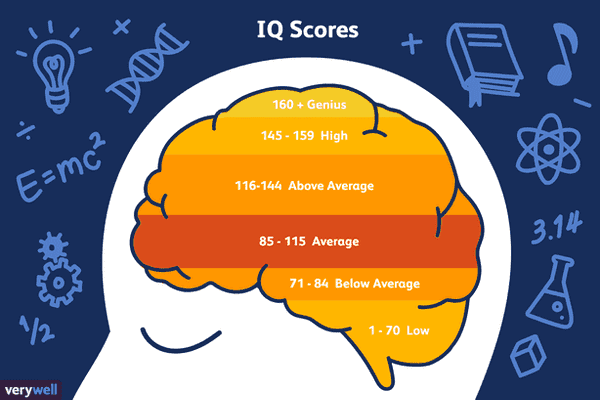
Classification levels in IQ tests - Image source: www.verywellmind.com, Joshua Seong
IQ tests traditionally focus on two main areas: linguistic communication and logical thinking. These areas are limited in assessing the intelligence of various segments of society, many of whom excel in areas that do not necessarily require linguistic or logical abilities.
This raises several questions for researchers in the field of intelligence measurement:
Is intelligence a general individual trait? How accurate are the available intelligence tests, whether online or at certified testing centres? Is intelligence the same for everyone around the world, with only varying levels? Is it fair to say that one person is more or less intelligent than another? Can we adopt a single perspective on intelligence despite the diverse areas of human excellence?
In 1983, psychologist and Harvard University professor of cognition and education, Dr. Howard Gardner, introduced his theory of multiple intelligences in his book Frames of Mind. Over the next twenty years, he continued to develop this theory.
Gardner’s theory posits that the human mind has seven different types of intelligence that function independently from one another.

Professor Howard Gardner, the creator of the theory of multiple intelligences - https://metode.org
In reading this book, several examples presented by the author stood out to me, illustrating the different types of intelligence and the invalidity of comparing them:
A 12-year-old Caribbean boy from a family of sailors who have passed down the trade from generation to generation. This boy, despite his young age, is a skilled sailor. His proficiency requires extensive knowledge of wind patterns, weather forecasts, celestial navigation, and geography, relying entirely on traditional methods without advanced navigation devices.
An Iranian child who amazed the media with his memorisation of the Quran at a very young age. He speaks Arabic fluently alongside his native Persian and excels in religious studies, potentially becoming a religious leader in the future.
A 14-year-old Parisian girl who has mastered a complex music application to produce unique and sophisticated musical compositions.
Each of these individuals can be considered proficient in their field, similar to sports legends in football or golf. They have achieved remarkable success in highly competitive fields.
However, traditional measures of intelligence might not capture their achievements because these measures are designed to assess only one type of intelligence.
If we conducted a public survey asking people to name the smartest person ever, most would likely choose names like Einstein or Newton, overlooking other highly successful individuals in their fields. This bias highlights the limitations of conventional intelligence measures.
In this book, or rather this theory, the author identifies seven types of intelligence, also known as multiple intelligences:
Linguistic intelligence
Musical intelligence
Logical-mathematical intelligence
Spatial intelligence
Bodily-kinesthetic intelligence
Interpersonal intelligence
Intrapersonal intelligence
One criterion Gardner used to define these types of intelligence is the possibility of their isolation if the brain suffers damage. If a part of the brain responsible for a specific type of intelligence is damaged, the associated abilities are lost without affecting other types of intelligence.
Another criterion is that each type of intelligence should enable problem-solving. This is why abilities like facial recognition are not considered intelligence in Gardner’s view; they may meet the first criterion but not the second, as they do not aid in problem-solving or acquiring new knowledge.
This leads to another question: Why should we identify and understand different types of intelligence?
To answer this, we must first ask: Is intelligence influenced by genetics?
While some scientists believe that up to 80% of intelligence differences can be attributed to genes, others argue that genetics play a minimal role, not exceeding 20%, while some dismiss heredity entirely as a determinant of intelligence.
Although one can estimate that a person has a high potential for excellence in a certain trait, if an individual with the potential to become the best chess player in the world is never taught the game or even made aware of its existence, their chances of achieving such greatness are nearly impossible.
Gardner’s theory of multiple intelligences can help identify and develop individuals’ hidden potentials.
From a genetic perspective, a stimulating environment has the greatest impact on enabling individuals to reach the highest levels of proficiency in areas that match their genetic traits. However, it is theoretically impossible to distinguish and separate genetic traits from those acquired environmentally.
This is where neuroscience comes in to explain and understand human cognitive traits. Fortunately, two principles from neuroscience can help us understand these traits: compensation and plasticity.
In the next part of this article, we will explore this relationship further and continue reading about the theory of multiple intelligences. We will also learn about internal and external sources of intelligence and the author’s suggestions for establishing scientific frameworks for measuring individual intelligence (especially in students) and how this measurement can improve the educational process.

Written by Husain Alghasra who lives and works in London building useful things. You should follow them on Twitter
Comments are currently unavailable.